



The first recorded references to the shrivelled, botrytised grapes known as Aszú in Tokaj date back to 1571, while mentions of Furmint, the charismatic grape variety that dominates the region today, appear some forty years later. It did not take long for the sweet wines of this historic area, located around 220 kilometres north-east of Budapest, to become not only among the most celebrated, but also the most expensive wines in the world.
For at least two centuries, Tokaji Aszú was the wine of choice for royalty and cultural luminaries alike. From European royal courts to the tables of great artists and thinkers such as Beethoven, Liszt, Schubert, Johann Strauss and Goethe, Tokaji enjoyed a status few wines have ever achieved. Yet the twentieth century proved devastating for this legendary vineyard. Phylloxera, the First World War, during which Hungary lost nearly two-thirds of its territory, the collapse of the Russian monarchy following the October Revolution, and the country’s subsequent alignment with the Eastern Bloc all contributed to a profound decline. The once-mythical Tokaj was gradually transformed into a producer of mass-market wines, their purpose no longer refinement or longevity, but volume. With the liberal addition of sugar, these wines were designed to satisfy the demands of a vast post-war socialist market, supplying inexpensive sweetness to consumers for whom prestige and terroir had all but disappeared.
What had once stood as a symbol of aristocratic taste and cultural sophistication was, for much of the twentieth century, reduced to an industrial product. The fall from grace was dramatic and would demand an equally remarkable renaissance.
The great wine writer Hugh Johnson was among the very few who had the privilege of tasting the greatness of the great nineteenth-century Tokaji Aszú wines rather than merely reading about them. Following the fall of the Berlin Wall and the profound changes it triggered across the socialist world, he went on, with the support of 62 local growers, to establish the region’s first private winery: the Royal Tokaji Company.
Alluvial soils over a volcanic subsoil, the moderating influence of the Tisza and Bodrog rivers, and a cold continental climate — Tokaj lies on the same latitude as Chablis — come together to form a terroir capable of producing both dry and sweet wines of world-class stature.
The Royal Tokaji Company’s range makes this immediately clear, even with its entry-level wine, the Dry Furmint 2021 (8/10), priced at just €15. Although already four years old, this remarkable blend of vineyards will ideally require at least as much time again to reach its peak. Even so, it is strikingly expressive today, articulating with clarity the flinty, sulphurous minerality and razor-sharp acidity that define Furmint — an acidity that even the wine’s partial ageing in Hungarian oak is unable, and indeed unwilling, to tame.
The Dry Furmint Vineyard Selection 2018 (8.5/10) raises both intensity and concentration to thrilling levels, unfolding into a vivid interplay of honey, smoke, fermentative notes and vanilla. Sourced from vineyards in the renowned sub-region of Mád, which also hosts the estate’s striking, state-of-the-art winery completed in 2010, the wine is equally impressive on the palate. It delivers remarkable volume and texture, more than sufficient to support its formidable 7.4 g/L of acidity. This is a superb wine that clearly calls for at least another eight years of cellaring.
It would seem difficult to go further, yet Szt. Tamás 2018 (9/10) proves otherwise. Ascending the hierarchy of the Royal Tokaji Company range also brings greater depth, ripeness and length. The eponymous first-growth vineyard allows oak to play a central role in a compelling composition of incense, smoke, yellow fruit and formidable structure. This is a wine built for the long term, with the potential to evolve gracefully until at least 2035.
The quality of the dry wines almost makes one forget the very reason this vineyard ranks among the most celebrated in the world. Almost. When the Late Harvest 2018 (8.5/10) reaches the glass, any resolve to resist sweetness tends to disappear instinctively. Incorporating a small proportion of honeyed Hárslevelű and yellow Muscat (Sárgamuskotály), this introductory sweet cuvée delivers measured apricot sweetness, refreshing lift and a vibrant yet creamy finish.
Things intensify dramatically with the Blue Label Aszú 5 Puttonyos 2018 (9/10), produced by adding berries affected by noble rot to a fermenting must of overripe grapes. Historically, the sweetness of Tokaji Aszú was measured by the number of puttonyos, the baskets filled with these botrytised berries that were added to a fixed quantity of base wine. In the glass, this golden-hued wine delivers a masterclass in the mushroom-like, earthy influence of Botrytis cinerea. Aromas and flavours reminiscent of crème brûlée unfold seamlessly on both nose and palate, lending a creamy, rounded dimension that beautifully tames the formidable acidity and supports the wine’s seemingly endless length. The result is a sweet wine of genuine world-class stature, where power, balance and complexity coexist in rare harmony.
The Gold Label 6 Puttonyos 2017 (9/10) delivers exactly what its designation promises: even greater botrytis influence and concentration. It balances an imposing 188 g/l of residual sugar against a striking 8.7 g/l of acidity. More evolved and more oak-driven than the Blue Label, this 100% Furmint sacrifices none of its freshness or energy. These qualities give it remarkable poise and longevity, making it a wine built not just for cellaring, but for passing on to future generations.
The Mézes Mály 6 Puttonyos 2018 (9.5/10) offers a similar level of sweetness, yet moves decisively ahead in terms of raw material. It comes from Mézes Mály, one of only two vineyards in the entire Tokaj region classified as a Great First Growth. This amber-hued masterpiece unfolds a sumptuous array of noble, mushroom-like botrytis aromas, but without tipping into overt honeyed heaviness. Instead, the flavour profile remains strikingly fresh, driven by riveting acidity and crystalline definition. A truly great sweet wine, where opulence and precision coexist in rare balance.
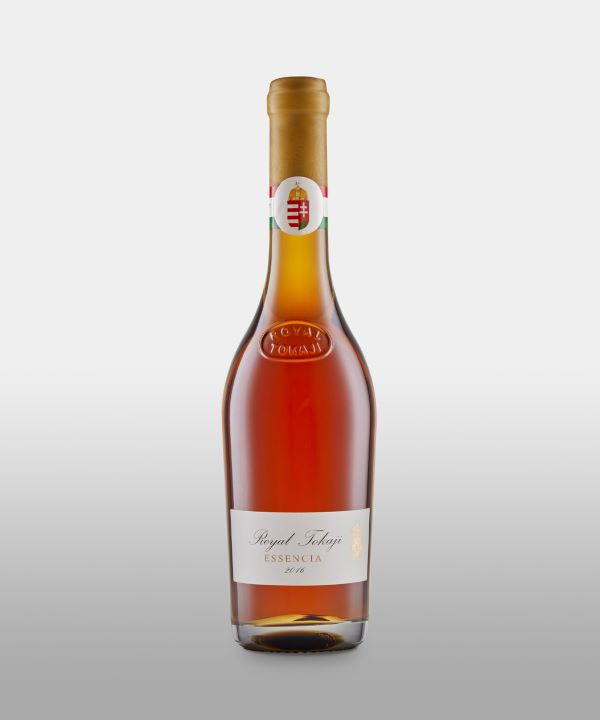
Although 6 Puttonyos marks the upper limit of sweetness within the Tokaji classification, Essencia 2016 sits entirely outside that hierarchy, firmly in what can only be described as hors catégorie. It is produced exclusively from the free-run juice of botrytised grapes, which drips slowly, drop by drop, into special vessels as the berries await the completion of the harvest before being transformed into Tokaji Aszú.
The term “fermentation” is almost symbolic here. This liquid of extreme luxury barely reaches 2% alcohol, while retaining an astonishing 535 g/l of residual sugar and 16 g/l of acidity. Essencia has been produced in only eight vintages across the winery’s 35-year history, and it takes 40 kilograms of grapes to yield a single 375 ml bottle. It is not served in a glass, but by the spoonful, with one teaspoon requiring the juice of approximately 720 individual berries.
If you do not happen to have €850, or indeed €30,000 for a magnum of Essencia 2008, you could attempt a playful approximation at home by mixing honey and sage infusion in equal parts, then adding lemon in the same ratio. It may give the faintest idea of the texture and balance of what is widely considered the most expensive sweet wine in the world, though the comparison can only ever be theoretical.
Whether the Royal Tokaji Company ultimately persuades the proletariat of the world to unite or to convert is open to debate. What is certain is that it leaves no one unmoved.
In Greece, Royal Tokaji Company wines are imported by Epic Imports (tel. +30 693 672 8342).


Login or register to join the conversation