



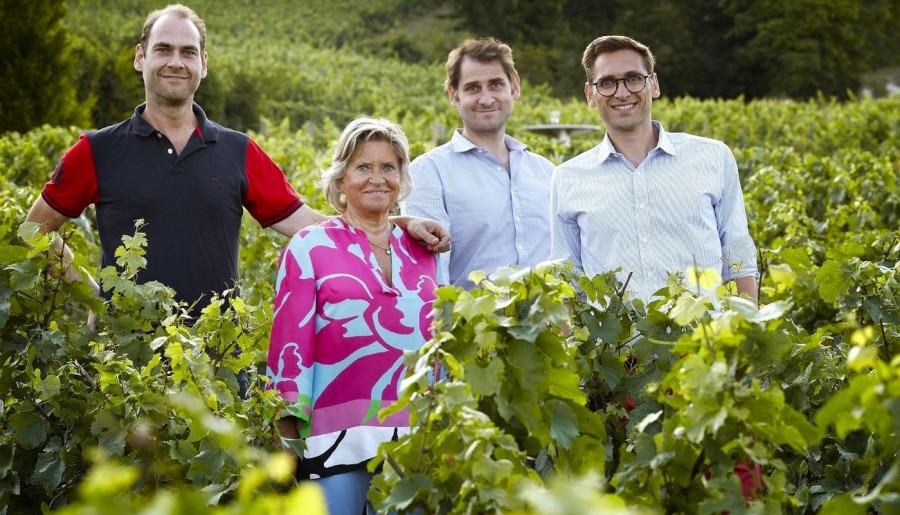
In 1991, Carole Duval-Leroy was thrust into a defining moment. Following the untimely death of her husband, Jean-Charles, she suddenly found herself at the helm of a major Champagne house in Vertus, while raising three young children. The challenges she faced, later described with candour in her book Femme de Champagne, were formidable. What proved even more remarkable, however, was her determination not merely to preserve the house, but to lead it forward with clarity and ambition.
Alongside raising her sons Julien, Charles and Louis, whom she carefully prepared as the next custodians of a demanding legacy, Carole Duval-Leroy reshaped the identity of the house. She positioned Duval-Leroy at the forefront of environmental responsibility in Champagne, introduced intelligent and forward-looking marketing strategies, and became the first woman to serve as President of the Association Viticole Champenoise, the region’s influential growers’ body.
All of this, of course, required time. Years, in fact, during which some of the house’s Chardonnay-driven Champagnes were left resting patiently on their lees, waiting for the right moment for disgorgement. Duval-Leroy farms around 100 hectares of vineyards, covering more than a third of its total grape requirements, a significant figure by Champagne standards. A further 40 per cent of its fruit comes from Premier Cru and Grand Cru villages. The wines discussed here are sourced exclusively from these privileged sites. Such extended ageing on the lees demands raw material of the highest calibre, capable of sustaining long periods of autolysis without losing precision or freshness. Most of these vineyards lie in the Côte des Blancs, the historical heartland of Duval-Leroy. As a result, the house style is defined by the dominance of Chardonnay, expressed through tension, clarity and a distinctly mineral profile.
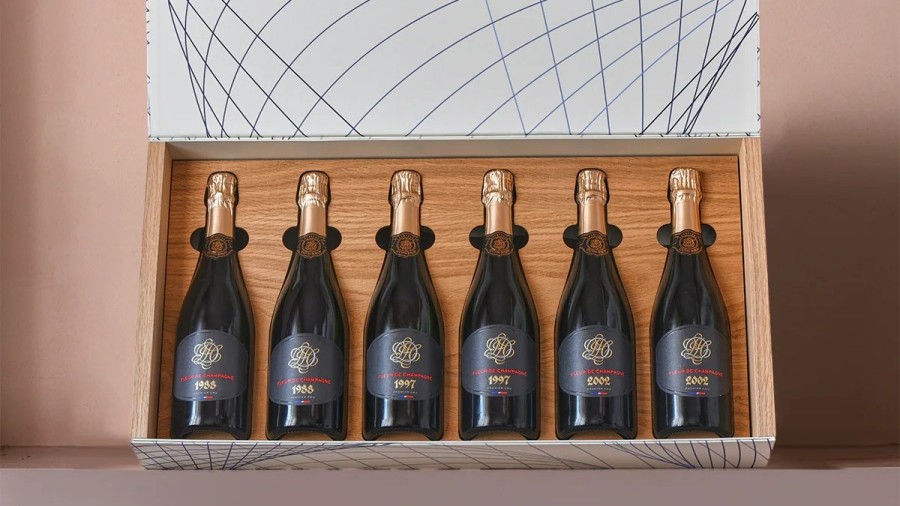
A large-scale disgorgement that took place last year created the rare opportunity for an exceptional tasting of six distinct sparkling wines. The journey began with the “black label” Fleur de Champagne Premier Cru NV (8/10). This black-labelled cuvée is clearly distinguished from its younger, white-labelled namesake by its extended ageing, more than ten years on the lees. Built around base vintages from 2010 to 2015, this Chardonnay–Pinot Noir blend (70/30) shows pronounced aromas of lemon, white flowers and digestive biscuit. Light in body, incisive in acidity and slightly tannic in structure, it calls for a few more years in bottle to fully harmonise.
Intensity is taken several notches higher with the Blanc de Blancs Prestige 2008 (9/10), a pure Chardonnay that spent an extraordinary sixteen years on the lees. Sourced almost entirely from Grand Cru vineyards (95 per cent), this wine delivers an expressive burst of butter, white almond and brioche. Despite its richness, it remains remarkably light on its feet, with greater flavour concentration and a beautifully persistent, nut-driven finish.
Rosé Prestige 1er Cru NV (8.5/10) delivers a beautifully refreshing expression and stands out as the youngest wine of the line-up. Based on the 2017 vintage, it is produced using a distinctive approach: 20% Chardonnay is blended with 80% Pinot Noir vinified as rosé. The aromatic profile is deliberately restrained, with subtle notes of dried red fruit, gentle spice and a hint of nettle. On the palate, however, the wine opens up dramatically. The mousse initially grips the throat with energy, before settling into a calm, supple and velvety flow that defines its charm.
The tasting reaches a near-meditative intensity with the arrival of Fleur de Champagne 1er Cru 2002 (9/10). The blend returns to the house’s classic 70/30 Chardonnay–Pinot Noir ratio, but here the wine has spent an astonishing 22 years on the lees. In that context, even Bollinger RD begins to feel almost youthful. Dense and expressive, this remarkable Champagne evokes butter, truffle and mushroom on the nose, while the palate retains a striking sense of balance and freshness, carried by remarkable persistence. And yes, astonishing as it may sound, it still calls for another five to ten years of bottle ageing.
This is not the end, but the beginning of a surreal trilogy, whose second act is the Fleur de Champagne 1er Cru 1997 (9/10). Now at its absolute peak, this Champagne is layered with aromas of mushroom and ripe yellow fruit, while its delicacy is matched by impeccable balance, a quietly noble power and a long, graceful finish.
It is difficult to think of another Champagne that has remained on its lees for 36 years (yes, years, not months) other than the Fleur de Champagne 1er Cru 1988 (9.5/10). This is a masterpiece that recalls a great Amontillado Sherry, only with bubbles. The bouquet unfolds notes of crème brûlée, mushroom and candied yellow fruit, while the palate delivers extraordinary length and flavour dominated by the unmistakable character of rancio. A wine capable of moving to tears anyone who believes that true greatness in wine is born through extreme ageing.
Two bottles from each vintage form the Heritage wooden case, designed by world-renowned tattoo artist Chaim Machlev, and released in just 750 sets. Each case is priced at €1,600, a figure that may initially seem extravagant. Yet, a closer look tells a different story. Divide €1,600 by six bottles and the average price comes to €266 per bottle, a figure that feels entirely reasonable when compared with the cost of many significantly younger Champagnes. Looked at another way, those €1,600 buy 170 years of lees ageing, meaning each year costs a mere €9.40.
Chapeau, Carole, Julien, Charles and Louis.
Duval-Leroy wines are imported in Greece by Wine Box
Tel. +30 210 725 4710


Login or register to join the conversation