



In 2026, Spondi marks 30 years of continuous presence, a milestone that carries rare weight for the Greek gastronomic landscape. More than simply a restaurant, Spondi has, for three decades, functioned as the benchmark of haute cuisine in Athens. It is a point of reference whose identity has been shaped to a great extent by its founder and owner, Apostolos Trastelis, through a relentless and uncompromising pursuit of excellence that gradually elevated the restaurant to an almost institutional status.
In my previous review, written two years ago, I noted: “It is the ultimate synonym for haute cuisine and everything it represents, and it has inevitably evolved into an academy of great taste, from which most of the chefs who have led the Greek culinary scene in recent years have effectively graduated.” That observation still holds true today. Looking ahead, the anniversary year is already being quietly prepared, with a series of celebratory dinners featuring major international names set to take place at Spondi. We will return to those when the time comes.
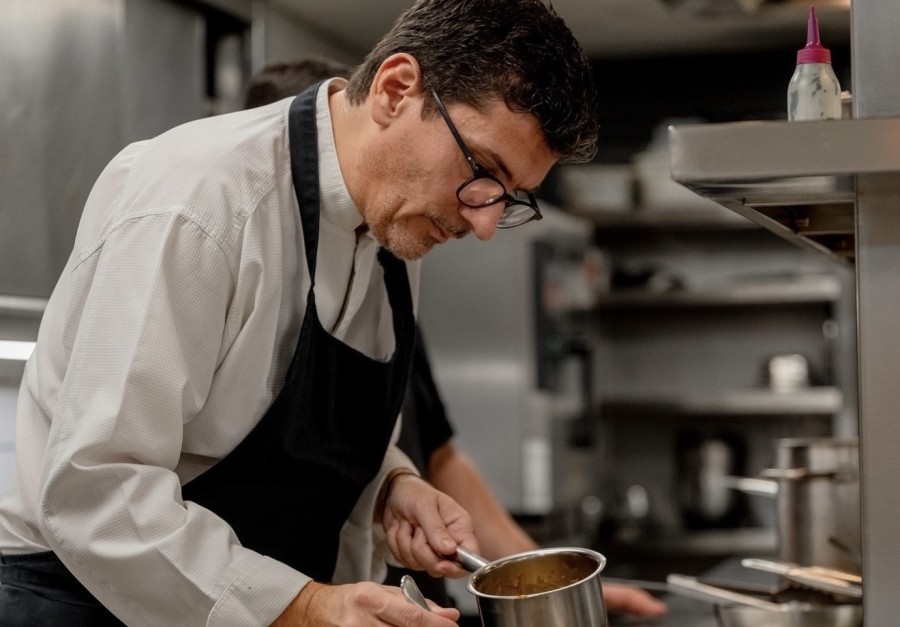
Let us now turn to the true core of this review: the cuisine of Arnaud Bignon, now clearly entering a markedly more creative and confident phase. What defines this moment is a rare equilibrium between refined, almost lyrical dishes and bolder gastronomic compositions that convey a sense of greater freedom, with fewer protective filters in place. Today, Bignon’s cooking displays increased assurance in its combinations. There are more aromatic layers, more complex garnishes, and a braver use of herbal notes and acidic elements. Texture is employed with intent, almost as a form of culinary punctuation. Velvety components carry and deepen the sauces, crisp elements awaken the palate, while warm and cool contrasts create elegant points of tension on the plate. In short, this is a chef operating at the height of his powers, and, crucially, at his most daring.
I will begin with a duo of dishes in which Bignon moves with surgical precision between two very different interpretations of the same primary ingredient, revealing the full range of his culinary language. In the foie gras parfait with pear, Japanese yuzushu liqueur and gavotte, he approaches a notoriously demanding ingredient with absolute control.
The foie gras, presented with disarming clarity, retains all of its richness and character, yet is integrated into a composition that feels light, poised and almost ethereal. This is a take firmly rooted in the classical canon, executed with such finesse that it appears effortless, even though it is anything but.
Shortly afterwards, the same ingredient appears on a completely different trajectory. Sautéed foie gras with raw oyster is a dish of density and tension. The warm, almost assertive presence of the foie meets the cold, mineral clarity of the oyster in a composition likely to challenge some diners. Here, Bignon’s cooking takes on another register, less mediated and more liberated. What I found most compelling is that he makes no attempt to force a reconciliation between foie gras and oyster. Instead, he allows them to converse on open ground, with broader aromatic spread and an instinctive sense of balance that feels confident rather than contrived.
Thirty years on, Spondi continues to give real meaning to the term “great restaurant.”
Langoustine, meanwhile, is one of Arnaud Bignon’s most cherished ingredients, and it is never absent from the menu at Spondi. In this version, it appears as a carefully orchestrated trilogy. First, the roasted tail. Then a brioche filled with langoustine, followed by a claw glazed in langoustine butter, and finally a refined langoustine tartlet that completes the sequence.What matters most, however, is not the number of preparations, but the way the dish is structured around three clear aromatic axes: fermented pine honey, kaffir lime, and curry. Together, they form an aromatic arc that bridges different culinary idioms without ever compromising the dish’s internal coherence. The pine honey evokes a Nordic forest, dense and resinous, with deep, wintery tones. Kaffir lime brings sharp, luminous freshness, acting almost like an aromatic pulse that reawakens the palate. Curry, in turn, binds these directions together, adding warmth and roundness.The langoustine is thus revealed in successive expressions, each distinct yet bound to a single, continuous narrative, as though one idea were unfolding across three movements. Complexity here does not stem from excess or technical bravura. It emerges when every ingredient, every texture, and every aromatic note operates on multiple levels, simultaneously and sequentially. When nothing is added merely for effect, but instead interacts, activating other elements, shifting temperatures, modulating intensity, and guiding the palate forward.That is precisely what happens in this langoustine trilogy.
On a menu defined by such clear direction and culinary consistency, the sea bass was the one dish that did not quite reach the level set by the rest. The gnocchi with anthotyro and spinach sauce are elegant and technically precise, yet they fail to integrate seamlessly with the fish itself. The Meyer lemon and Greek saffron sauce brings a welcome sense of freshness and rounded acidity. Meyer lemon, being more aromatic and naturally sweeter than conventional lemon, delivers fragrance without sharpness. Alongside it, the green sauce of spinach and fig-leaf oil offers attractive vegetal depth and a pleasing bitterness. Taken individually, each element is executed to a high standard. As a whole, however, the dish never quite finds the common register that would bind these components into a single, coherent narrative.
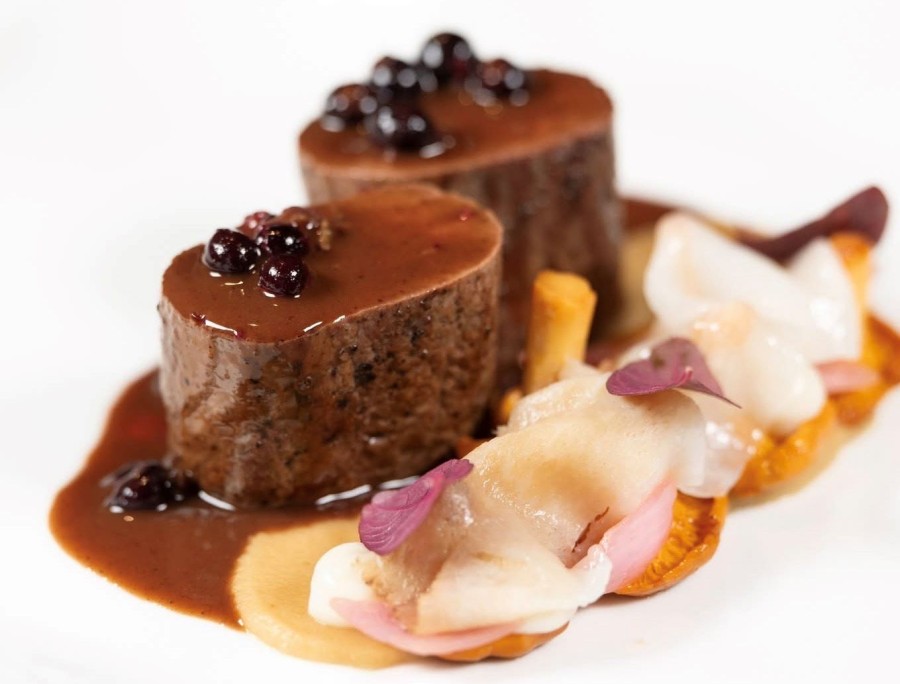
Moving on to the menu’s heavy hitters, the pigeon and the venison are two dishes of considerable power. The pigeon is cooked with exemplary precision, achieving a rare balance between depth of flavour and refinement. It retains its texture and character without losing elegance. Crisp lettuce brings a cooling freshness, umeboshi adds a finely calibrated acidity, ginger provides lift, and the sauce is delicately worked, precise and beautifully restrained. The venison, served with parsnip purée, girolle mushrooms and an impeccably judged redcurrant sauce, is equally impressive. Perfectly cooked, focused and clean in expression, it demonstrates the kitchen’s command of game and its ability to deliver intensity without heaviness.
On the current menu at Spondi, there is a dessert that deserves to be recorded as a benchmark. Tahitian vanilla with caramelised brioche and hazelnut is, without exaggeration, the finest dessert one can taste in Greece at the moment. The delicacy of the vanilla, the airy texture of the cream and the caramelised, almost buttery richness of the brioche leave a lasting impression that recalls haute pâtisserie, yet carries the emotional pull of a childhood memory.
Thirty years on, Spondi continues to give real meaning to the term great restaurant. And while it could easily rest on its status as a symbol, what I find most compelling is that it does not. It operates as a restaurant that refuses complacency, that takes risks, that remains contemporary and deeply pleasurable, and that continues to evolve. Compared to my previous review, where I scored it 8.5 out of 10 with an upward arrow, and after three further visits in the interim, I now see a clear and confident momentum. Despite the misstep with the sea bass, the overall picture leads me convincingly to a 9 out of 10. This is not an act of generosity on my part, but a vote of confidence in a kitchen that demonstrates not only that it remembers what the summit looks like, but that it has both the ambition and the appetite to reach it again and, perhaps, even surpass it. At the very least, nothing in this dinner allowed me to think otherwise.
- Spondi
- Phone: +30 210 7564021
- Address: Pirronos 5, Athens 116 36, , Αθήνα
- Website: https://www.spondi.gr/en/
- Open: Daily from 7:30pm to 1:00am
- Price per person (€)*: 140+
- * we do our best to reflect the actual price range per-person of a full meal including first and main courses, desert, water and half a bottle of wine or one beer depending on the type of restaurant.
- 0 - 4
- Poor
- 4.5 - 5
- Average
- 5.5
- Acceptable
- 6 - 6.5
- Good
- 7 - 7.5
- Very Good
- 8 - 8.5
- Outstanding
- 9 - 10
- Excellent
| 0 - 4 | 4.5 - 5 | 5.5 | 6 - 6.5 | 7 - 7.5 | 8 - 8.5 | 9 - 10 |
| Poor | Average | Acceptable | Good | Very Good | Outstanding | Excellent |
| *"arrow-symbol": the up arrow to the right of the rating, if it appears, symbolizes a restaurant that is close to moving up to the next ranking rung. | ||||||


Login or register to join the conversation