



In temperatures that often exceed 40°C, with desert sand whipping into your eyes whenever the wind picks up, a music festival has been taking place in Indio, California since 1999 that has, over time, become something of a holy grail for influencers. A place where they can step away from the outside world while, at the same time, competing within it, surrounded by thousands of phones filming selfie videos and documenting every detail: what they wore, what they ate, what they saw, which song moved them, and even the price of the bag carrying their Evian facial spray.
In its early years, Coachella had a distinctly alternative and rock-driven identity, but over time it has opened up to all genres and today arguably boasts some of the most extensive line-ups in the world. What sets it apart from festivals such as Glastonbury or Lollapalooza is not the calibre of the artists, but the fact that it has evolved into an event where simply being there is as important as what is actually happening.
Everything is structured to function as part of an image you construct for social media. Sponsors and participating brands collaborate with this in mind from the outset, creating moments designed to be shared. Naturally, food could not be left out of this equation.
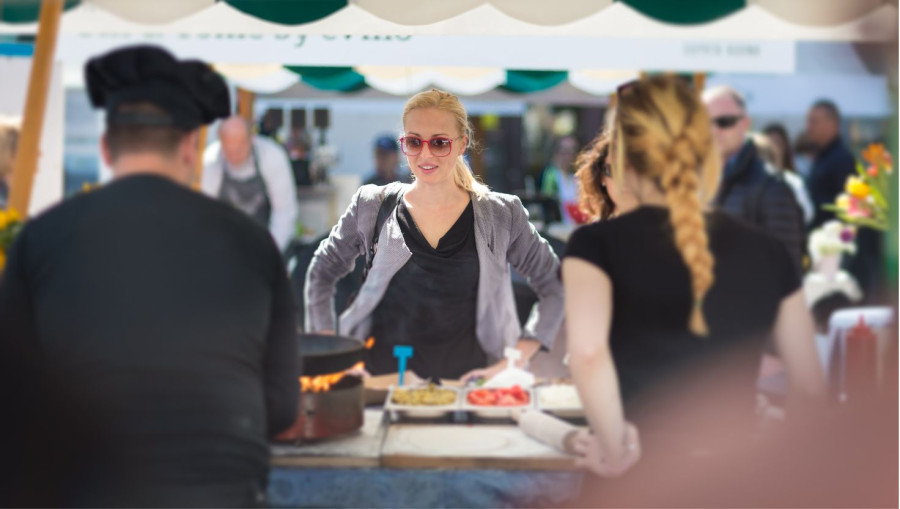
More than 100 restaurants, bars and pop-ups operated within the festival, offering a genuinely wide range of options. From street food and food trucks to fine dining concepts that required reservations months in advance, the spectrum was notably broad. This year’s line-up included names such as Dave’s Hot Chicken, Prince Street Pizza from New York, known for its signature square slices, Roy Choi’s Kogi, widely credited with pioneering gourmet street food in Los Angeles, and Sweetfin, a well-known plant-based chain. The “Outstanding in the Field” concept by Jim Denevan also returned, featuring a four-course dinner with a different chef each evening.
The widely known Nobu, set in an environment where a gust of wind carrying off your napkin was the least of your concerns, offered an omakase experience starting at $375, while a comparable menu at its Malibu restaurant begins at around $100. If that already feels somewhat excessive for a music festival, the Michelin-starred team behind Camphor had chicken nuggets topped with caviar ready to serve to those who could not imagine listening to Justin Bieber with anything less, comfortably seated under a VIP tent.
For those on a more modest budget, Dave’s Hot Chicken was selling chicken sandwiches with fries for $30, nearly three times the price at its regular outlets. At the same time, two slices of pizza with a soft drink could easily exceed $40, while a simple coffee would set you back $17.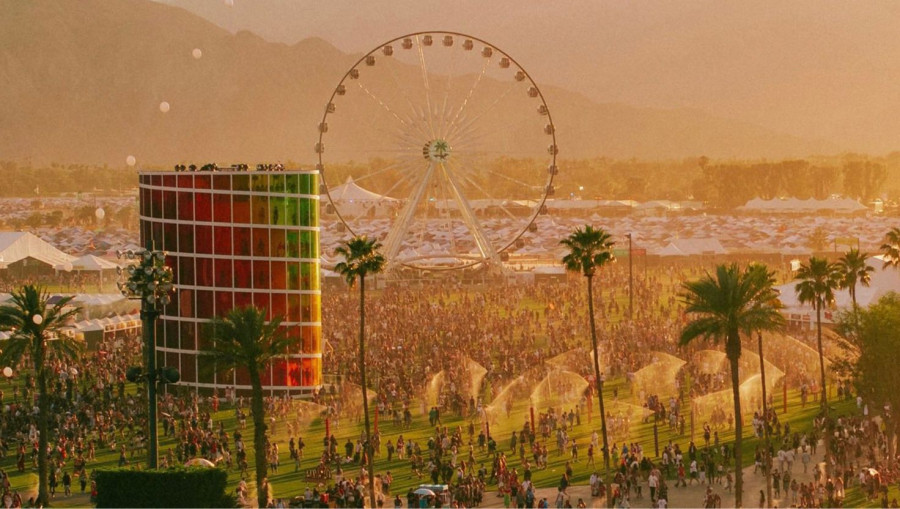
All of this led some influencers to share their receipts on social media, complaining about the prices, despite having already paid around $600 for a festival ticket. Others, more relaxed about the cost, argued that the pricing was still better than at an airport and that, in that sense, it should be seen as reasonable.In practical terms, the reality of 2026 meant that a visitor to Coachella could expect to spend between $100 and $150 per day on food alone, excluding drinks. At the same time, airport pricing, particularly that of New York, seemed to emerge as an unlikely benchmark for comparison.
Between ourselves, Coachella has always been an expensive proposition, especially when you factor in travel and accommodation for the weekend on top of the ticket. What it did offer, however, was a sense that you could navigate the experience according to your budget.
This year, that flexibility feels largely gone. There is no truly inexpensive option, only a less expensive one. Food has become an integral part of the festival’s identity, while sharing receipts from food stalls has, somewhat inevitably, turned into content in its own right.
The more attention the Nobu omakase attracts, the more Coachella effectively promotes itself, making it clearer than ever who the festival is really aimed at.
It is no longer enough to be a music fan to find yourself there. Beyond the cost, there is an unspoken expectation that your personal style aligns with the visual language of the festival, that you are comfortable in front of a ring light, have a substantial following on TikTok, and can photograph a plate of chicken topped with caviar, whether or not you fully understand what you are looking at.
Today, Coachella has evolved into a global music event shaped as much by content creators as by the music itself. And yet, despite everything said above, I would still very much like to be there, even if only for a few hours.



Login or register to join the conversation