



Through the always-welcoming FNL Guide, I try to bring to the forefront – and to recommend – wines of every style and every price point. In fact, because I am often invited to some of the premium tastings held in Athens, and therefore tend to cover that segment quite frequently, whenever I attend broader wine exhibitions I make a point of focusing on the less “flashy” bottles.
That was certainly my intention when I walked through the doors of Trinity’s impressive annual presentation, which this year carried the title INFINITY 2025. But I made the mistake of moving counter-clockwise instead of clockwise – and time effectively stopped when I suddenly found myself in front of a cluster of red Bordeaux whose calibre ranged from “very good” all the way to “mythic”.
It’s not the first time something like this has happened to me. I always tell myself, “Do your job first and come back later for pleasure.” And, invariably, the result is either that the wines have been finished – after all, how often does one have the chance to taste bottles worth a month’s salary? – or that I’m in such a state by the end that I can’t even find my way back to them.
This time, though, I stopped, tasted, and enjoyed them (even if half of the wines were from the relatively modest 2017 vintage). And once again I realised that no matter how much some people try to elevate wildly expensive wines from obscure hillsides, Bordeaux remains the most powerful brand name in the wine world, and its great châteaux the definitive symbols of both financial and vinous prestige.
Château Clinet 2017: The historic Pomerol estate - its 11.5 hectares have been cultivated since 1595 - uses Cabernet Sauvignon rather than Cabernet Franc alongside Merlot, giving this vintage higher acidity and firmer tannins than the regional norm. The dense, expressive nose shows molasses, sweet strawberry and camphor. Will improve over the next five years. (8/10)
Château Ducru-Beaucaillou 2017: The iconic yellow label of this great Deuxième Grand Cru Classé encapsulates almost 300 years of perfectionism. With an unusually high proportion of Cabernet Sauvignon (90%), the 2017 is still tight and tannic, but dusts its sweet fruit with notes of ash and graphite. Needs at least 20 years. (9/10)
Château Gazin 2017: For its 2017 vintage, this Pomerol château opted for 95% Merlot and 5% Cabernet Franc. The dominance of Merlot brings a relatively sweet, balanced palate with aromas of red-black fruit and herbs. Already enjoyable, it should peak around 2030. (8/10)
Château Gloria 2017: Created half a century after the 1855 Classification, Château Gloria officially holds the status of a simple Saint-Julien — though there is nothing simple about it. The most approachable and affordable wine in this tasting nonetheless offers impressive complexity: raisin, floral notes, fresh grass and graphite. Light-footed but characterful. (8.5/10)
Lafite Rothschild, Château 1999 Magnum: Now twenty-six years old, this red shows exactly why Lafite remains one of the greatest wines on the planet. With at least 75% Cabernet Sauvignon in the blend, this masterpiece delivers an indescribable intensity of cedar, cigar box and graphite, impeccable balance, and the potential for another decade of life. (9.5/10)
Léoville Poyferré, Château 2017: Even in a challenging vintage, this 2ème Cru Classé from Saint-Julien offers a lesson in classic Bordeaux typicity and depth. Dense, dark and utterly opaque, the 2017 is full-bodied, still firm and not yet settled into its oak. Yet after 2040 its grandeur will fully reveal itself. (9/10)
Palmer, Alter Ego 2017: The second wine of the illustrious 3ème Cru adds a touch of Petit Verdot (6%) alongside Merlot and Cabernet Sauvignon. Concentrated yet aromatically closed, with cedar and black-fruit notes, it is relatively delicate, soft and bright with acidity — though it still needs at least five more years to come into its own. (8/10)
Pez, Château 2018: It may not hold Cru Classé status, but the 650-year-old Château de Pez has long been in exceptional hands — most recently those of the Roederer Group — and the results are superb. Abundant tannins supported by sweet fruit and a distinctly “dark” profile make this delicious both now and in years to come. (8.5/10)
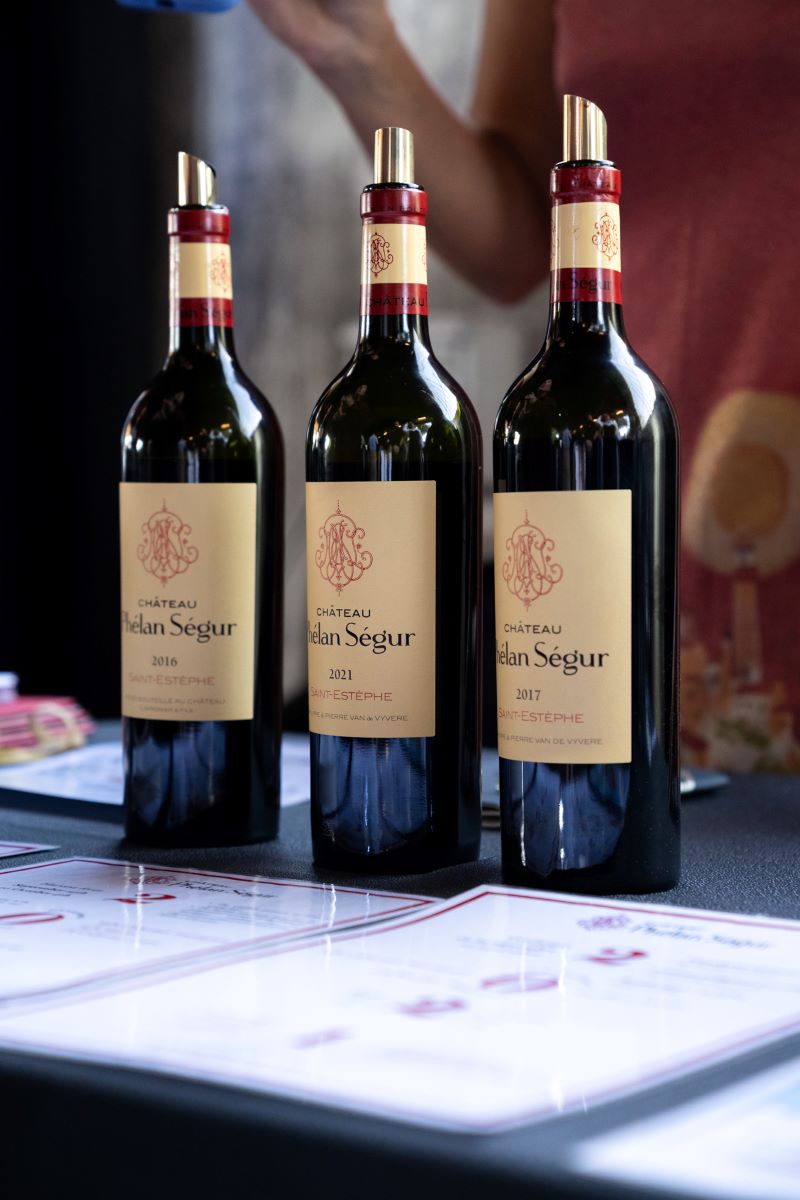
Phelan Ségur, Château 2016: Phelan Ségur has long distanced itself from its former Cru Bourgeois status — and vintages like 2016 prove it was right to do so. In the glass it outclasses many Cru Classé estates: astonishing concentration of inky depth and black fruit, abundant wildness yet enough freshness to carry it for another 15 years. Spectacular. (9/10)
Phelan Ségur, Château 2017: The 2017 includes a relatively high proportion of Cabernet Sauvignon (65%), meaning that even in this challenging vintage it delivers solid flavour, structure and length. However, the fruit on the nose has slipped into a jammy phase, limiting any long-term ageing potential. For drinking now, though, it is thoroughly enjoyable. (8/10)
Phelan Ségur, Château 2021: Dr Hannibal Lecter may have preferred the ’96, but the 2021 shows the same ruthless profile. Packed with acidity and tannin, it brims with concentrated herbal notes and even denser black-and-red fruit. It needs at least 15 years, so it might not be ready before the next sequel appears… (8.5/10)
Pichon Longueville Comtesse de Lalande, Château 2014: The legendary Pauillac estate — widely regarded as a super-second — leaves no room for doubt with its 2014. Yes, it’s still a little disjointed and firmly tannic, but the inky concentration and formidable length guarantee a 30-year ageing potential. (9/10)
Pichon Longueville Comtesse de Lalande, Réserve de la Comtesse 2016: It may be the second wine, but that means very little when we’re speaking about one of Bordeaux’s greatest châteaux. A benchmark in typicity, this cedar-laden cuvée opens with sweet fruit, delivers vigorous flavour and finishes with a supple, polished feel. (8.5/10)
Pontet-Canet, Château 2015: The Pauillac producer remains one of my personal favourites — and the exceptional 2015 explains why. Dense aromas of ink and black fruit, persistent flavour and a firm structure that promises another two decades of greatness. Unfortunately, the price now reflects its true worth… (9/10)
Rauzan-Ségla, Château 2017 (3-litre): The illustrious history of this Margaux estate is mirrored in its 2ème Cru Classé status. Initially, the Cabernet-dominant blend (two-thirds Cab Sauv.) shows bright red fruit and violet, but it darkens and deepens with air. The 3-litre bottle, however, is already drinking with considerable softness. (8.5/10)


Login or register to join the conversation