



Knystaforsen had been on my list for quite some time. Following the work of Nicolai and Eva Tram on social media, I was fascinated by how they had transformed an old sawmill on the banks of the River Nissan into something far beyond a restaurant — into a place where fire, water, and the rhythm of nature are all part of the experience itself.
When I found myself in Sweden, it was only natural that I would make the journey to the small village of Rydöbruk, to meet the couple who left Copenhagen behind in order to rediscover themselves in the forest. As idyllic as that decision may sound, their beginning was far from easy, and the risk they took was immense — personal, financial, even existential.
Nicolai Tram had spent years working in the kitchens of Copenhagen and Spain, following the relentless pace of fine dining — until, eventually, it wore him down. In 2017, he and Eva decided to leave behind the noise of the city in search of a different way of life. That search led them to Rydöbruk, where they moved into an old sawmill on the banks of the River Nissan.
They made it their home — and that’s why the restaurant still carries the warmth and intimacy of a family hearth. In the beginning, nothing was in place: no proper kitchen, no electricity, no real plan for what would come next. There was only fire. Nicolai lit the first one to cook, and in its flame, he rediscovered his desire to create.
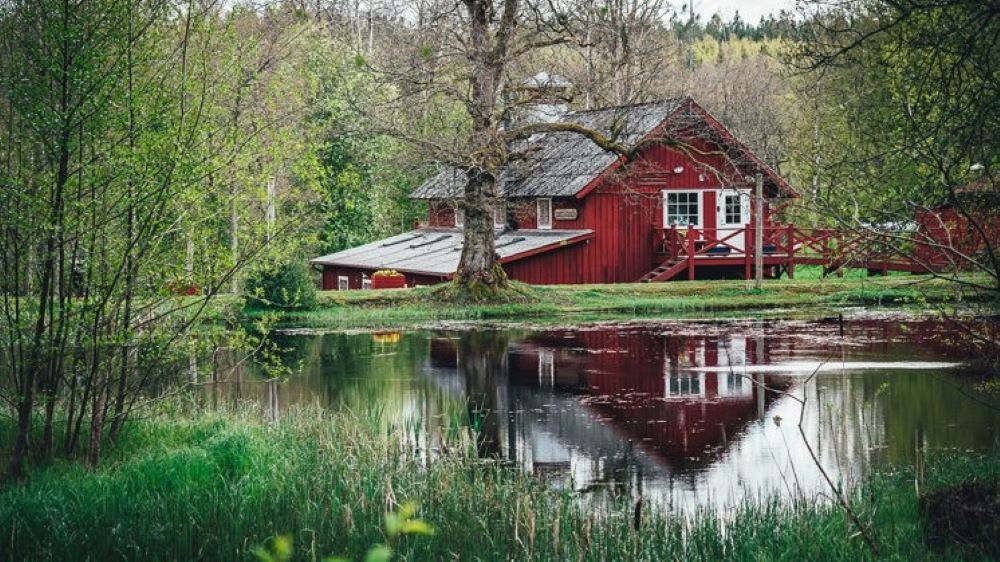
Knystaforsen takes its name from the waterfall of the River Nissan that flows beside the building. In Swedish, the word describes the rushing sound of water breaking the silence of the forest — an image that perfectly reflects the rhythm of this place.
The restaurant opened in 2020, three years after Nicolai and Eva Tram settled in Rydöbruk. Two years later, Knystaforsen was awarded both a Michelin Star and a Green Star for its sustainable philosophy — recognition of a journey built entirely on respect for nature and self-sufficiency.
Fire is the defining element at Knystaforsen. Nicolai Tram uses it with instinctive ease — as a natural extension of his own thought process. Most dishes pass through flame or smoke, yet what matters most is how fire shapes the very spirit of his cooking: it’s immediate, honest, original, elegant, and profoundly flavourful.
Tram himself seems carved from the same material as the landscape around him — waxed moss-green shirt, leather apron, wide-brimmed hat. His presence is calm, focused, almost ritualistic. He stands before the fire like someone who understands its power and knows exactly how to guide it. That same quiet mastery flows through his entire team.
Eva Tram, on the other hand, moves differently through the space. Where Nicolai is absorbed by the kitchen, she sets the rhythm around him — observing, coordinating, creating the atmosphere that allows guests to relax. Everything she does carries a sense of grace, almost lightness.
She also oversees the wine programme, designing pairings that converse both with Nicolai’s dishes and with the surrounding landscape. Her selections range from small Swedish producers to more unexpected European labels, all chosen for their intensity and balance. The experience at Knystaforsen bears her signature just as clearly as it does his.
When it comes to the food at Knystaforsen, from the 18-course menu I’ll focus on a few standout dishes that truly stole my heart.
First, the grilled leek with pike roe, buttermilk, and burnt dill oil — a dish that balances flame and finesse with remarkable clarity. The leek has the softest, most velvety texture I’ve ever encountered; it melts like silk on the palate, leaving an earthy, impossibly tender aftertaste that lingers.
Two other plates that perfectly capture the restaurant’s philosophy were the grilled duck hearts served with charred onion, pheasant jus, and burnt dill oil, and the venison, beautifully cooked over the fire with bone marrow, wild berry sauce, and thin shavings of truffle.
The experience reaches its climax with the flambadou, one of Europe’s oldest cooking tools, originating in southern France, once used by shepherds and village cooks. It’s a heavy cast-iron cone fixed to a long handle, heated in the embers until it glows red-hot. When fat or butter is poured inside, it bursts into flame, sending streams of fire and smoke cascading over the food.
At Knystaforsen, Nicolai and Eva Tram have revived this forgotten technique, turning it into the beating heart of the evening. Guests gather around the fire as the fat drips, the flames rise, and the food is bathed in light. It’s a brief ritual — both a finale and a signature of the entire experience.
Rating: 8.5 / 10
- 0 - 4
- Poor
- 4.5 - 5
- Average
- 5.5
- Acceptable
- 6 - 6.5
- Good
- 7 - 7.5
- Very Good
- 8 - 8.5
- Outstanding
- 9 - 10
- Excellent
| 0 - 4 | 4.5 - 5 | 5.5 | 6 - 6.5 | 7 - 7.5 | 8 - 8.5 | 9 - 10 |
| Poor | Average | Acceptable | Good | Very Good | Outstanding | Excellent |
| *"arrow-symbol": the up arrow to the right of the rating, if it appears, symbolizes a restaurant that is close to moving up to the next ranking rung. | ||||||



Login or register to join the conversation