




The question, then, is whether designers truly understand the feminine narrative of elegance — or whether they have detached themselves entirely from it, pursuing instead their own visions and runway “statements”, often with little connection to what women actually desire, aesthetically or otherwise.
We often hear the phrase “this designer loves women”, but shouldn’t that be a given? Of course, no one means this in a romantic or sexual sense, but rather as a deeper appreciation — an ability to understand the female world, to interpret it, and to honour what it represents.
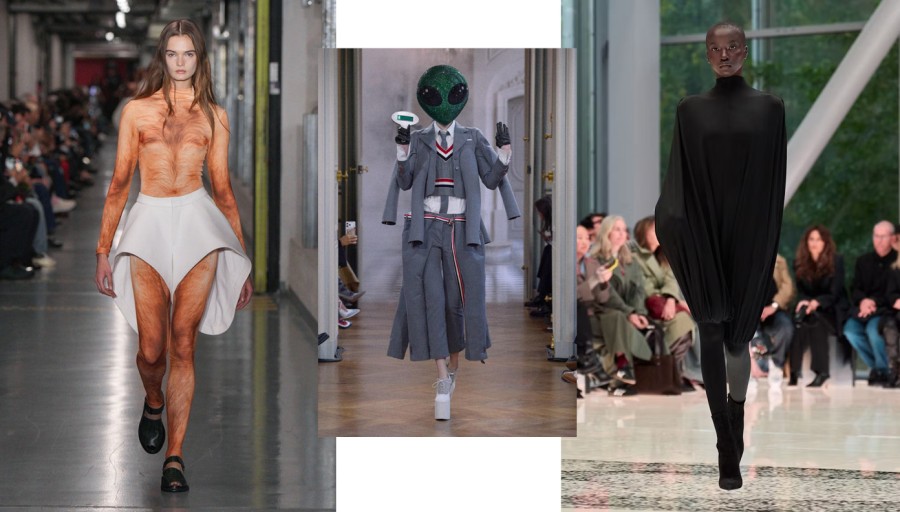
In 2023, 2024, and again this year, fashion weeks around the world have often revealed a widening gap between what women actually need and what many designers seem intent on expressing — a fixation with runway “statements” that illustrate their own eccentric fantasies. Surrealist imagery, masked faces, alien-like silhouettes, and (very) dramatic proportions have blurred the line between art and absurdity.
Of course, deconstructive forms are nothing new — Rei Kawakubo has been exploring them for decades, and continues to do so with unmatched vision. Yet Kawakubo’s approach to the female form has always been grounded in respect and reinvention. Her work exalts the body in all its shapes — powerful, singular, and unmistakably feminine — even when it rejects conventional ideals of beauty.
The same could be said of John Galliano, whose theatrical excess has never undermined femininity, but rather celebrated it, making the female figure the centrepiece of his imagination. Alexander McQueen, too, was a master in his study of the female body — his work was provocative, but never indifferent to it.
Many younger designers, however, seem torn between unrestrained fantasy and the reality of womanhood. Their collections no longer speak of beauty — nor even of its deliberate rejection as a social statement — but instead reduce women to instruments for expressing their own restless need for “creative freedom”. It’s a pursuit that often leaves a chasm of misunderstanding between the designer and their true audience: women themselves.
The Lost Balance Between Fantasy and Function
At the most recent Paris Fashion Week, the balance between fantasy and function seemed to collapse — quite literally. Do today’s designers still know how to dress a woman, or are they simply intent on making a “statement”? The question was raised repeatedly, even by Suzy Menkes herself, who wondered why there was so much nudity in Haider Ackermann’s second collection for Tom Ford. She also asked where the house’s original elegance had gone.
It’s almost ironic: the modern woman’s presence doesn’t need to be reinvented. Clothes should be defined by her, not the other way around — even when design pushes boundaries and embraces bold ideas. Has creativity, then, become a symbol rather than a practice — a gesture of expression rather than an exercise in the true craft of tailoring and design?
As creative directors change as frequently as seasonal fruit, the question becomes even more pressing. Pieter Mulier’s recent collection for Alaïa was intriguing and technically assured, yet featured sleeveless dresses that trapped the models’ arms inside the garments — beautiful, perhaps, but conceptually unsettling. At Maison Margiela, Glenn Martens’s latest show turned the house’s signature stitches — the four tacks that usually appear on the outside of garments — into metal braces, fitted grotesquely into the mouths of models to hold them open. A bizarre and unnecessary reference to BDSM iconography, made all the more jarring by the presence of a children’s orchestra performing in the background.
And in the much-criticised debut of Duran Lantink for Jean Paul Gaultier, bodysuits printed with the hairy torso of a naked man took centre stage — a provocation that seemed to confuse discomfort with depth.
Who Are These Clothes Really For?
True innovation in fashion does not come from excess alone, but from garments that understand — and respect — the power and complexity of the female form. Today, many designers appear torn between wild imagination and the lived reality of modern womanhood. And while creativity soared in the most recent shows, practicality was often nowhere to be found.
The result was a visual spectacle that left audiences asking a simple question: Who are these clothes really for? This imbalance exposes fashion’s all-too-frequent struggle to merge imagination with relevance — and serves as a reminder that art, without empathy, inevitably leads to alienation.
Part of the problem lies in the rapid turnover of creative directors, who have become, rather inelegantly, disposable commodities in the machinery of modern fashion. When designers are replaced after a single season, how can there be continuity, depth, or understanding? Among younger creatives especially, the pressure to shock — to be talked about — too often replaces the desire to create something lasting. In the end, that impulse tends to backfire.
Perhaps It’s Time to Remember the Obvious
Designers cannot afford to work in isolation from the reality of their audience — as in the case of Duran Lantink’s collection for Jean Paul Gaultier, mentioned earlier, whose erratic vision risked fragmenting the legacy of a truly historic house.
Paris Fashion Week, as many commentators observed, seemed once again caught between fantasy and functionality, raising the serious question of whether designers still understand the women they are meant to dress. One only has to look — the shows are all there on Instagram — at Thom Browne’s recent collection. A designer celebrated for his fairytale sensibility, this season he pushed further than ever, blurring the line between performance art and wearable fashion.
Even the undeniably brilliant Rei Kawakubo, through her latest work for Comme des Garçons, once again pursued conceptual fashion — this time questioning what a garment actually is. Intellectually fascinating, yes, but visually challenging and, ultimately, not meant to be worn.
Today, the spirit of Pierre Cardin — who decades ago envisioned fashion’s future as geometric, space-age, and liberated from gender — reappears through new utopian ideas. Yet few contemporary designers manage to channel Cardin’s clarity of vision, his ability to translate innovation into coherence. Too often, the creative directors of major houses seem to mistake provocation for purpose, turning design into a statement that fails to resonate.




Login or register to join the conversation