



Almost a year has passed since I first made the journey to Atelier Moessmer, in the small town of Brunico, above Bolzano, close to the Italian–Austrian border, and yet what I experienced in those mountains continues to resonate. Why? Because it was an experience both rare and singular, almost transcendent, precisely because it engages with something far greater than flavour alone. It explores how cuisine defines its relationship with place, with time, and with the people who inhabit it.
The three-Michelin-starred Atelier Moessmer demonstrates, in the most tangible way, how a restaurant can be built around a humanistic idea, honour it consistently in every detail, and transform dinner into an opportunity to reconsider what haute gastronomy means today.
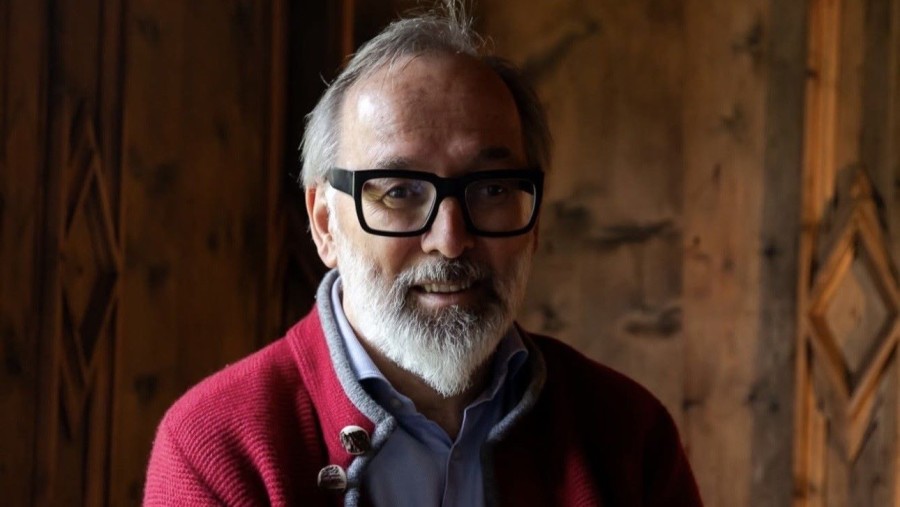
This philosophy has a name: Cook the Mountain. It also carries a significant and internationally recognised signature, that of Norbert Niederkofler. At its core lies a coherent system of principles that defines how a kitchen can be organised when it chooses to take its geographical and social environment seriously.
In practical terms, Cook the Mountain is built on three fundamental pillars. The first is strict geographical restraint in sourcing ingredients. This is not rhetoric, but a non-negotiable rule. The kitchen works exclusively with what the mountain region surrounding the restaurant can provide, consciously rejecting the convenience of international suppliers.
The second pillar is respect for time. Seasons are not treated as a decorative narrative device, but as a determining factor in shaping the menu, the techniques employed, and the methods of preserving ingredients.
Finally, there is the relationship with the local community. Farmers, livestock breeders, food artisans and the restaurant team itself form a single ecosystem, and the success of the kitchen is measured not only by what appears on the plate, but also by whether it strengthens or undermines that environment.
At a practical level, applying these principles means that Atelier Moessmer consciously accepts a series of constraints. Acidity is sought in local fruits and fermentations, while intensity and depth are built through smoking, ageing and reduction. At Atelier Moessmer, luxury is not defined by rare or “prestige” ingredients, but by precision in the use of what is available, and by the kitchen’s ability to extract the maximum potential from every part of each product.

Norbert Niederkofler stands at the centre of this world in a way that is almost invisible. His authority is evident in the dishes themselves, in their precision and emotional depth, yet he chooses to share the space with everyone who gives this cuisine its substance. Through his work, he opens a broader conversation about the relationship between production, product, place and guest, and demonstrates in practice a model in which haute gastronomy nourishes and strengthens the community that surrounds it.
At the heart of this ambition is a tightly knit and deeply committed team. Norbert himself acts as both director and mentor, while Mauro Siega holds the pivotal role of executive chef, and Lucas Gerges serves as the restaurant’s dynamic general manager and wine director. Around them is a young generation of cooks and sommeliers who choose to build their careers in an Alpine valley rather than in a global metropolis. That choice alone speaks volumes about the strength of the philosophy and the clarity of the message it conveys.
What is most striking is seeing this manifesto come alive on the plate, unfolding in flavour, technique and creativity, and turning into a sequence of small, interconnected stories across the table. From his time at St. Hubertus, Niederkofler brings with him several emblematic dishes, available à la carte, including a white fish tartare, beetroot gnocchi, and a beautifully judged tart tatin that is at once deeply delicate and quietly rustic.
From there, the creative pace intensifies, giving way to more complex compositions that serve the narrative with absolute clarity. His cooking operates as a dialogue between past and future. It draws on preservation techniques that have existed for centuries, while embracing technology in the service of precision, always leaving spectacle firmly to one side.
Atelier Moessmer operates as a genuine think tank, a description Niederkofler himself uses often. It is a place where ideas are tested about what the kitchen of the future might look like in a world of clearly defined limits. How luxury is redefined when resources are finite. How we avoid exhausting an environment that is already under severe pressure. And how haute gastronomy stops treating abundance as an assumed right and begins to regard every ingredient as a loan from the landscape.
Leaving Brunico, you carry with you images and flavours that could easily become cinematic frames, or case studies in what a restaurant looks like when, just four months after opening, it made history by being awarded three Michelin stars in one stroke. Personally, I also packed another thought. Every place, perhaps even every restaurant, has the potential for its own version of “cooking the mountain”. Not necessarily in the literal sense, but as an approach to cooking that respects its environment, supports its people, and claims its place in a freer world, one in which we choose more ethically how we eat and, by extension, how we live.
- 0 - 4
- Poor
- 4.5 - 5
- Average
- 5.5
- Acceptable
- 6 - 6.5
- Good
- 7 - 7.5
- Very Good
- 8 - 8.5
- Outstanding
- 9 - 10
- Excellent
| 0 - 4 | 4.5 - 5 | 5.5 | 6 - 6.5 | 7 - 7.5 | 8 - 8.5 | 9 - 10 |
| Poor | Average | Acceptable | Good | Very Good | Outstanding | Excellent |
| *"arrow-symbol": the up arrow to the right of the rating, if it appears, symbolizes a restaurant that is close to moving up to the next ranking rung. | ||||||


Login or register to join the conversation