


Rarely does a place present and combine in perfect harmony with intense contrasts. But these contrasts and their artful, effortless combination make Mani unique, captivating all who tread its land. Wild nature brings about serenity, cliffs and rough pebbles that plunge into clear, calm waters, imposing turreted villages that electrify and, at the same time, relaxed and endless underground caves that lead to the depths of the earth and cause admiration and shivers.
The history of Mani is lost in the centuries. It was first inhabited in the Palaeolithic era, appeared in Homer`s writings, fought with Arabs and Franks, became a base for pirates, remained stubbornly disobedient to the Turks and declared the beginning of the `21 revolution. Despite its heavy historical legacy, it seems to owe its name to its sparse vegetation since "manos" in ancient Greek means "sparse". Administratively, Mani is divided into Laconia and Messinia, but those who have visited it feel the beating of a single heart. With over 180 km of coastline and 1,800 sq km of total area, it offers enchanting images and experiences.
East Mani - Setting sail for Taenaro
One of the most beautiful tours of Mani follows its coastal roads and starts from Gythio, where houses with tiled roofs and neoclassical buildings carved on a green hill are reflected in the waters of the Laconian Gulf. The octagonal lighthouse of 1873, the Tzannetakis tower of 1829 on the small island of Kranai, and the shipwreck "Demetrios" on the nearby beach of Selinitsa are of great interest. Going down towards Tainaros, the beach at Vathi Ageranou is paved with coarse sand and has sunbeds in several places. In contrast, that of Alypa strongly resists organisation. Its large, white stones, turquoise waters and stone houses, and the rocks that hug it, "starred" in John Cassavetes` film Tempest, stealing many hearts worldwide.
In the small village of Laya, Papa George has gained fame for his baptisms in the Laconian Gulf and for his tavern, the " Commonplace in Lageia", where he daily sets the table with traditional delicacies, such as the omelette with seglino and wild oregano, the kayanas with fresh tomatoes from their garden and the musky milk pie. Passing Porto Cayo, there is another beautiful beach - Vathi and this one in the name. However, a fifteen-minute hike is required before diving into its waters and admiring the surrounding rocks, forming a natural pool. A few "steps" further down stands the famous Taenaro - the southernmost point of mainland Greece. Here, our mythology claims, is the gate of Hades. Here, too, are the ruins of Roman baths and the temple of Poseidon, which also served as a funeral parlour. So, turn northwards since there is only the vast sea south of the sixteen-metre lighthouse of Tainaros.
West Mani - The most walkable spots in the Laconian land
Heading up towards Avia, in the northern part of the western Mani, on a bend the towers and stone buildings of the imposing Vathia loom up (article presentation photo). Although deserted in winter, a visit and the utterly stunning mountain route to it is an absolute must. Nearby is anchored Gerolimenas. The picturesque port owes its existence to the trading company founded there by the Kirimi family in 1870. Today, the old stone trading houses have been converted into an elegantly luxurious hotel, the Kyrimai. The restaurant`s cuisine treads comfort paths, delivering local recipes with creative touches. Standouts on the menu include gongs with mutton brezhe and Maniakos paspalas which, while traditionally made with flour, at Kyrimai is made from a porridge of ground trahanas and served with seafood or beef cheeks. The wine list, curated by Perry Panagiotakopoulos, emphasizes small Greek wineries.
In the mountainous village of Stavri is Stavriani Zervakakakou`s restaurant Aspasia. Leaving the kitchen leadership at Annie Fine Cooking in Athens, the Maniati chef spread her restaurant`s marble tables under the thatched roof and olive trees and welcomed guests for the first time this summer. Her highly distinctive cuisine combines fresh, local and mostly seasonal produce. The menu changes daily, so I`ll suffice to mention the exquisite handmade sourdough bread I tasted, accompanied by lupin, coarse salt and Nomia Estates` extra virgin olive oil, and the pasta with Chianti, nouboulo, rooster and galena buns, which was garnished with fresh figs and grated Syrian cow`s gruyere. Stavriani intends to indulge in foraging, so her dishes will feature rare local products such as onions, headcheese and jujuboules in a spoon dessert.
A little further north, the Diros caves are nothing short of a natural wonder, with the one at Vlychada offering a thrilling boat ride among stalactites and stalagmites hundreds of thousands of years old. Visiting early in the morning is advisable to avoid the crowds that build up after 10 am. Passing through the Bay of Diros, Limeni, the seat of the Mavromichalai, and Areopolis, the historic capital of Mani, make their appearance. It retains its traditional architecture with its stone houses and beautiful cobbled streets, which, unfortunately, are overrun in the summers by bench seating and a patchwork of music. In the village`s central square, where the banner of the revolution was raised, "hides" the two-hundred-year-old Bakery of Mrs Milia. From its wood-fired oven comes daily fermented village bread, travichtes (traditional Maniakian pies), lalangia and many other goodies.
The next stop is Oitylo, one of Mani`s most picturesque and beautiful settlements. Built at 256 meters, it impresses with its architecture and spectacular view of the surrounding area. The settlement has two elegant boutique hotels. "Engraved" on the rocks, the Petra & Light has its eyes on Limeni and Neo Oitilo, while the Petriti Guesthouse, housed in a 19th-century mansion, is also attractive.
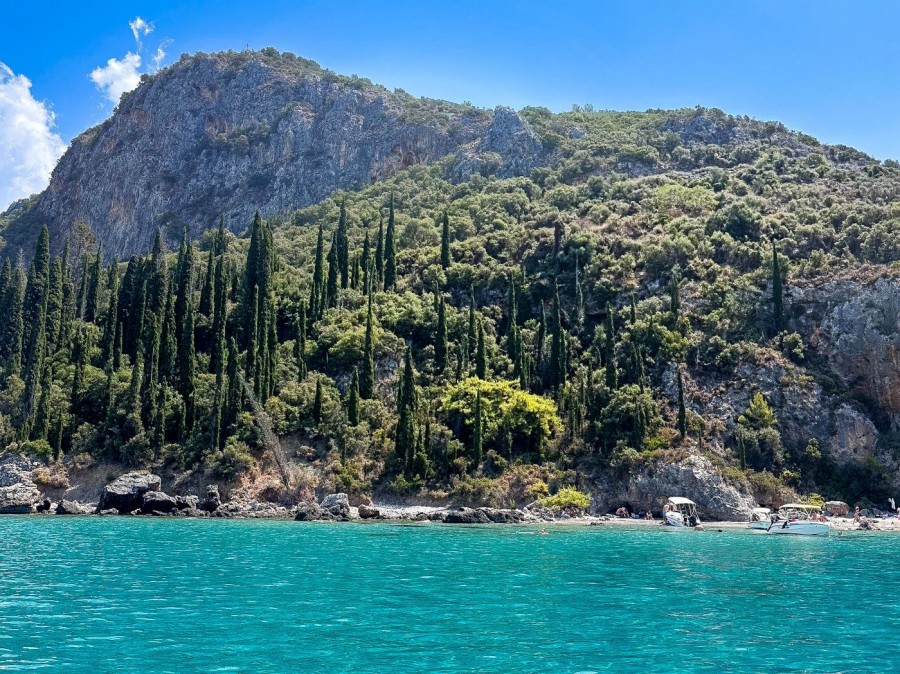
West Mani - Kardamili and its surroundings
The seaside village of Trachila marks the entrance to the Messinian Mani. A short distance from the town, and after a ten-minute hike that gets a little adventurous in a couple of places, a narrow path leads to the vast marble slabs of the shelter. On one side of them dominates the entrance to a unique cave, with 1.6km of channels, and on the other, a seductive sea of teal colours, access only allowed by diving off the rocks.
Around 6 kilometres further up, the beach of Kalogria, where Kazantzakis met Georgios Zorbas, is famous for its white sand and the cold sea due to the underwater springs of Taygetos. Friends of exploration can reach the nearby Turkospilia by swimming or riding a sea bike for a dip in the cave. The beach of Foneas is also stunning, with its majestic rock standing in its deep green sapphire waters, the trees that embrace it and its thick pebbles.
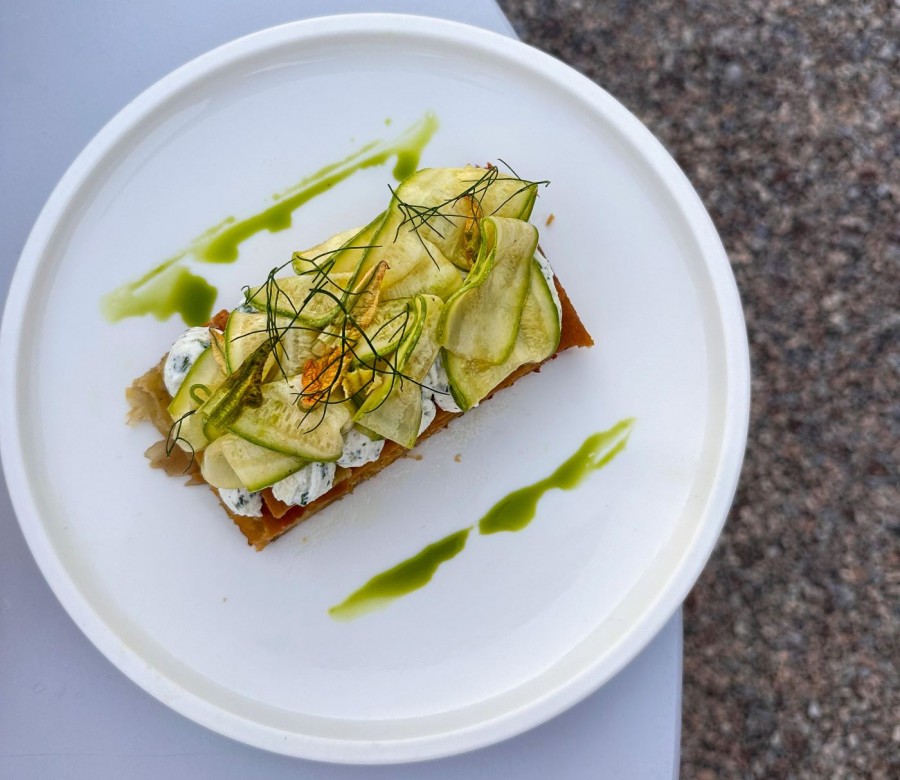
Kardamili, full of cypress trees and olive trees that reach the sea, "attracts" those who prefer a more relaxed and quiet setting. The third and last act of the great love story of the Before films, Before Midnight, was played in its serene palace. The meek little village is also of greater gastronomic interest than the other villages of Mani. Lela`s Taverna is in the centre of Kardamyli, with a front-row view of the sea. Lela Giannakea, personal cook of the English writer Patrick Leigh Fermor - whose house in Kalamitsi has been turned into a museum - opened the tavern in 1983. In the hands of the third generation, the family business has evolved into a restaurant of contemporary Greek cuisine, with chef Dimos Balopoulos (Forte, Kaliya) curating the menu. Respecting tradition and local produce, the chef has created a comprehensive list of delicious dishes, among them the white-berry cacio e pepe with Greek jamon Kermes, the open pumpkin pie and the rooster pastitsada with noodles and Ios gruyere cream. The Giannakea family `s restaurant ventures include Elies (pictured above), who was awarded an FNL star. Set against the backdrop of Ritsas beach amidst a lush olive grove, Elies offers homey hospitality and incredible stews of traditional Greek cuisine - epic moussaka, delicious giants and succulent stuffing among them.
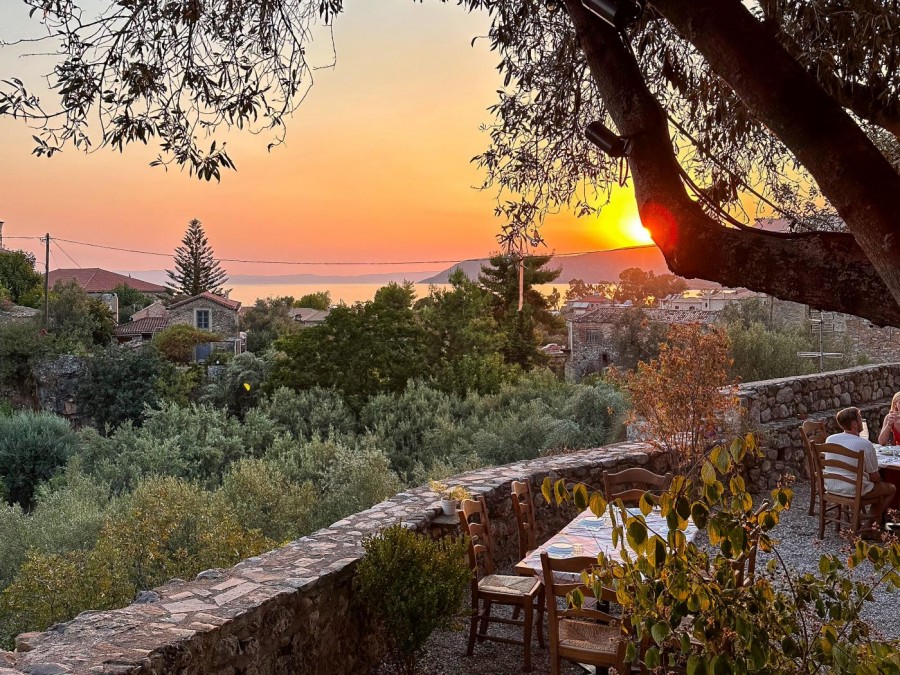
The culinary repertoire of the Old Kardamyli (photo above) by Mariolena Kalaroutakou, George Chiourea and chef Takis Kikentzis is also rich, set up this July in the shadow of the famous Mourtzinou Tower. Paved with gravel, the restaurant`s courtyard is overgrown with trees and offers a unique view of the olive groves and the sea. Its flavours are traditional, and its raw materials come from Mani and Kalamata producers. The honey-cured lamb with baked potatoes, the pastitsio, the okra with caramelised onion, lime and chopanomyzithra and the excellent galaktoboureko are some dishes I highly recommend. The Diapori, almost at the entrance of Kardamyli, is one of the most remarkable hotels in the area, and it has brand-new facilities and magnificent sea views.
Whenever I wander around the Mani "alleys", I discover new secrets and reasons to return since it is hard to complete my exploration. As fascinating as the tour that flirts with the sea is, the one that follows mountainous roads, with stops in picturesque villages "pinned" to the steep slopes of the emblematic Taygetos. The place`s charms are endless, while in recent years, its gastronomy has been gradually evolving, making the excursion to Mani`s haunts even more tempting.
*Photo Anna Tasioula


Login or register to join the conversation