


Coats began to replace capes in everyday Western dress towards the end of the 18th century. By the early 19th century, during Britain’s Regency period, the garment had found its most influential champion in George Bryan Brummell, the legendary English dandy better known as Beau Brummell.
This was no coincidence. Brummell became famous for his radical approach to men’s dress, favouring impeccably tailored coats, restrained silhouettes and precisely judged colour combinations at a time when excess and ornament still dominated male fashion. His insistence on cleanliness, cut and fit laid the foundations of modern menswear as we understand it today. Brummell was for a time a close companion of the Prince Regent, later King George IV, and exerted considerable influence over courtly style. Their relationship, however, eventually deteriorated. Brummell’s sharp wit and increasingly pointed criticisms of the Regent’s appearance and weight, combined with his mounting personal difficulties, led to a definitive rupture between the two men. What endured was Brummell’s legacy. Through him, the coat ceased to be merely practical outerwear and became a statement of discipline, elegance and social identity, a role it continues to play in men’s fashion to this day.
The decline and revival of the coat
Despite the popularity they enjoyed at the time, coats fell out of favour after the end of the Regency period, remaining in relative obscurity for several decades. During the First World War, however, the widespread use of trench coats by soldiers reignited public interest in the garment. So strong was this resurgence that, in the decades that followed, the coat became an essential element of men’s dress, adding a sense of authority and presence to those who wore it. Most men considered a coat a necessary part of their wardrobe, while women embraced the style just as enthusiastically, often owning two or three different versions to complement their outfits.
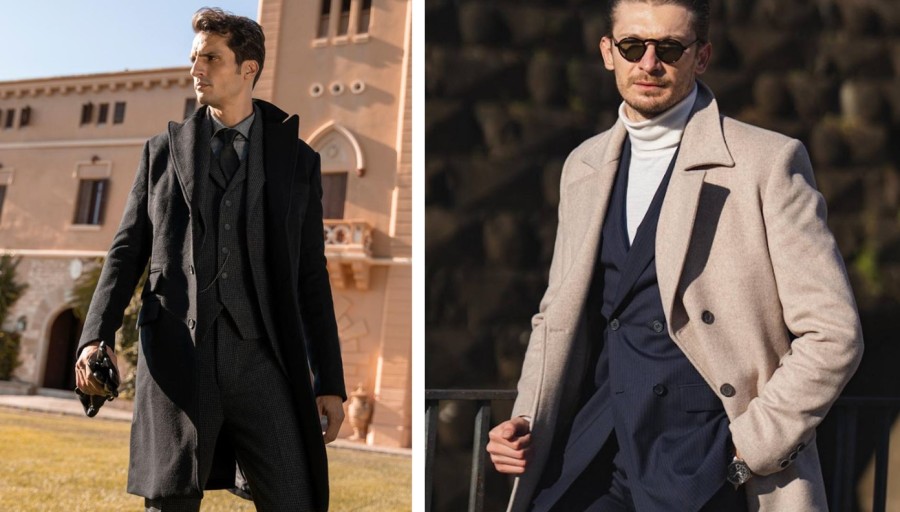
What exactly is a coat?
A coat is a single-breasted outer garment, usually falling below the knee, whose primary purpose is practical: to protect the wearer from the cold, while also adding elegance to the overall appearance. Although it was traditionally regarded as a more formal item of dress, today it can just as easily be styled with casual clothing. That said, a coat is always intended for low temperatures, which is why it is typically made from heavy, high-quality wool. Over the past two decades, however, clothing habits, particularly among men, have changed dramatically. Younger generations are often less likely to own a coat, favouring oversized jackets instead. Despite this shift, all major fashion houses continue to include coats consistently in their collections, as admirers of classic dressing remain loyal to the garment. In contemporary fashion, coats are available in a wide range of fits and proportions. They may be slim and tailored or relaxed and loose, cut well below the knee or significantly shorter in length.
Colours
Although coats have traditionally been produced in darker shades, as these absorb and retain heat more effectively, today we encounter many lighter-coloured variations. Beige, for example, is an exceptionally versatile and neutral option that pairs easily with a wide range of colours. Deep brown and navy blue are also two particularly popular choices. And then there is black. A colour widely loved across many categories of clothing, yet less dominant when it comes to coats. That said, black offers several clear advantages. It is less prone to showing stains, an important consideration given that coats are not easily washable and generally require dry cleaning. At the same time, black visually elongates and slims the male silhouette, while lending the wearer a timeless and refined appearance.

Fabric materials
Animal fibres are ideally suited to the fabrics used for coats. Wool, produced from sheep, is a natural material with a high keratin protein content, which is responsible for many of its properties, including its natural water resistance. Cashmere, sourced from the renowned Kashmir goats, is exceptionally soft and lightweight, with one particularly valuable advantage: it does not readily absorb unpleasant odours. Alpaca wool is another luxurious animal fibre, obtained primarily from animals bred in South America. It is lightweight, hypoallergenic and far less prone to pilling than many other fibres. Of course, the market also offers coats made from blends of animal fibres and synthetics. This approach is common even among major fashion houses, as it allows manufacturers to improve durability while also moderating prices, given that natural raw materials are particularly costly.
Ideal temperatures for wearing a coat
It is difficult to wear a coat in conditions where the temperature exceeds 10 degrees Celsius. Although contemporary fashion occasionally presents versions that are supposedly suitable even for spring or autumn, we would advise against it. Even in their lightest form, coats are outer garments that will keep you warm very quickly.
A coat is also a piece of outerwear that does not follow rigid rules, unlike a suit jacket, which traditionally remains fastened. If you feel warm, you can simply leave it open without any loss of elegance. In fact, because it is a garment that is typically removed once you move indoors, it works equally well with both formal and casual attire. In this season’s collections, beyond the more eccentric, brightly coloured fur coats that appeared, adding a sense of theatricality for those who embrace them — but certainly not for admirers of a timeless, classic aesthetic — the dominant shades were beige, khaki, white and black. After all, fashion, even menswear today, continues to invent ways to attract consumers. That audience, however, is often less interested in longevity and more drawn to trends, which, unfortunately, are closely associated with fast fashion.


Login or register to join the conversation