





Decades later, in 2008, during their own minor battle, Weezer found themselves listening to their record label—a voice that, in the polite and indirect manner of the music industry—advised them to adopt a more modern and commercial sound. As is well known, simplicity combined with authenticity does not always sell as well as a carefully engineered product designed for the charts.
However, the band`s principal songwriter, Rivers Cuomo, responded almost instinctively by writing a song about how he intends to eat, dress, and sing exactly as he wishes—delivering it with the same disarming simplicity as a plate of pork and beans. When the song was announced, many fans of the band initially thought it was an April Fools’ joke, until everything was confirmed with the album’s release. The music video for “Pork and Beans” won a Grammy at the 51st Awards, and the track went on to become one of the band’s most successful songs to date.
While pork with beans has become associated with every roadside restaurant along America’s highways—those offering “homestyle” dishes to complement their burgers, hot dogs, and pancakes—this humble yet hearty dish has survived through centuries, crossing continents and cultures.
In southern France, Cassoulet is more than just a meal; it’s a battleground of regional pride. In Carcassonne, Toulouse, and Castelnaudary, locals will insist their recipe is the authentic one. Typically, it features white beans, Toulouse sausages (Saucisse de Toulouse), duck or pork confit slowly simmered in an earthenware casserole dish, forming a crispy crust on the surface after hours of gentle cooking.
In Brazil, Feijoada holds the status of national dish. It is usually prepared every Saturday, using black beans and almost any edible part of the pig—ranging from ears to tail. It is traditionally served with spicy Farofa and fresh orange slices.
Across the Atlantic in the United States, Van Camp’s canned Pork and Beans has fed generations of soldiers, migrant workers, and truck drivers.
In China, Hong Shao Rou is a slow-cooked pork belly bathed in a rich soy-based sauce, often accompanied by Doubanjiang — a fermented bean paste made from soy, chili peppers, and wheat.
This simple yet globally beloved combination reflects a universal appeal—an enduring comfort food that has adapted to each culture’s unique culinary landscape, yet remains rooted in its hearty, soul-satisfying essence.
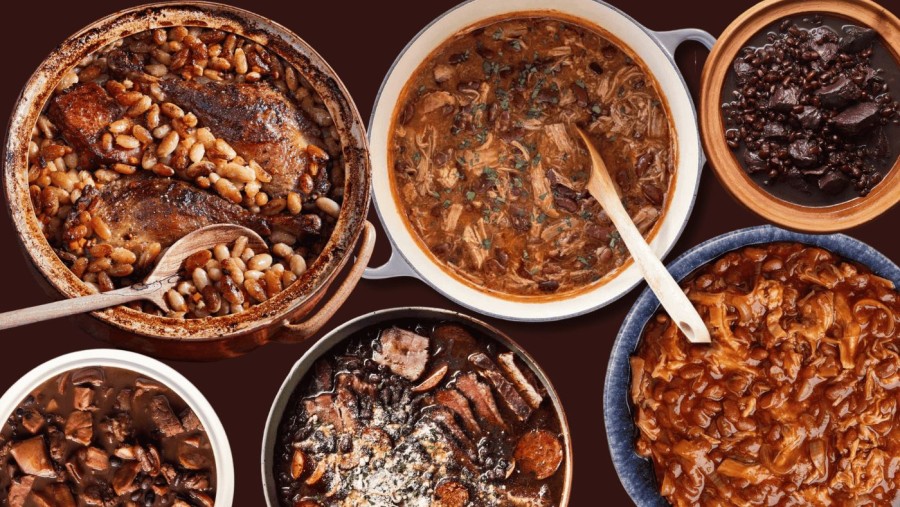
In Greek households, fasolada with pork, even if not cooked together, is easily paired with leftover meat from the previous day. Whether it`s pancetta, sausages, pork loin with or without bones, beans always have a place in the fridge—usually stored in a white plastic container that, in the end, is difficult to clean.
This is a dish that is far from glamorous—well away from the polished façades of influencers—yet it fills the home with a warm, comforting aroma, complemented by the smoky richness of rendered fat.
In this way, a dish that started out of necessity has become a symbol—reverberating from dining rooms to our speakers. Weezer did not write “Pork and Beans” necessarily to sing about beans and pork, but rather to raise the middle finger to those who manipulate the music industry, with no real connection to true music. The success of “Pork and Beans” demonstrated that there will always be space for simple things, full of character—just like a can of Van Camp’s in an American kitchen, a cassoulet made by an elderly Frenchman who puts the casserole in the oven for ten hours without a timer, or a house in Epirus smelling of smoked sausage and slow-cooked beans in a clay pot.
It’s a testament to the enduring appeal of honest, straightforward food—no matter how humble—that celebrates tradition, character, and the comforting simplicity that connects us to our roots.




Login or register to join the conversation