Ricard Camarena chose a particularly interesting way to revisit the idea of the Spanish bar and everything it represents. He took the concept away from Valencia’s historic centre, to the seaside neighbourhood of El Cabanyal, and created what has quickly become one of the city’s most talked-about openings.
NO BAR occupies the lower level of Kora Lluna, a contemporary hospitality complex, in an area that until recently was not among Valencia’s most obvious gastronomic destinations. Since opening last March, however, the rhythm around it has changed. Camarena’s new project has drawn both locals and visitors to this side of the city, many of them perfectly willing to wait for a seat.
The old fishermen’s quarter still retains its street life, the energy of its market, its maritime identity and a deeply rooted bar culture. Camarena was not simply looking for an interesting backdrop. He placed the restaurant in a neighbourhood where the bar remains part of everyday life.
The counter fills from the morning onwards, tables turn over quickly and a queue often forms outside. There are no reservations. You arrive, you wait, and you sit down when a place becomes available. For Camarena, that spontaneity lies at the very heart of the project.
“We cannot call somewhere a bar if you have to make a reservation. At the bar in your village, if you asked them to reserve a table, they would laugh at you,” he says.
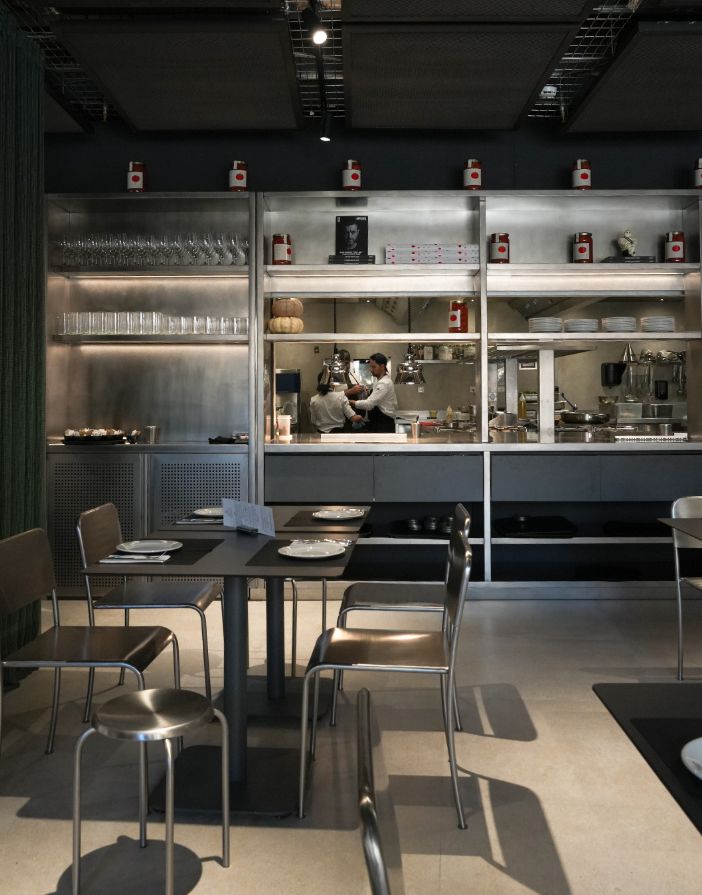 A Bar Without Nostalgic Styling
The space avoids both the hushed formality of a gastronomic restaurant and any attempt to recreate the traditional Spanish bar. Metal, steel, exposed brick and shades of grey shape an interior that feels somewhere between an urban arcade and a carefully composed industrial dining room. At its centre, a large communal table and an imposing bar organise the flow of the space.
In the morning, very different crowds come together under the same roof. Guests staying at the complex come down for breakfast, locals stop by for the traditional Valencian esmorzaret, visitors arrive having read about the new opening, and Camarena’s regular followers come to see which direction he has chosen to take this time.
The philosophy of the bar is still there, as is the way people move through the space. Even the dishes that arrive at the table feel familiar, only approached from a different starting point. Camarena and his team did not simply set out to create a menu of bar food. They began with that familiar world and used it as a point of departure to take the idea somewhere else.
That is precisely where NO BAR becomes interesting.
Aubergine, Tomato and a Sense of PlaceThe creamy buñuelo of fried aubergine and red miso captures the kitchen`s logic in just a few bites. Its thin, crisp exterior gives way to a soft, almost molten centre, while the miso adds depth and savoury intensity. Small in size and immediately satisfying, it is the kind of dish that quickly makes you want to move on to the next.
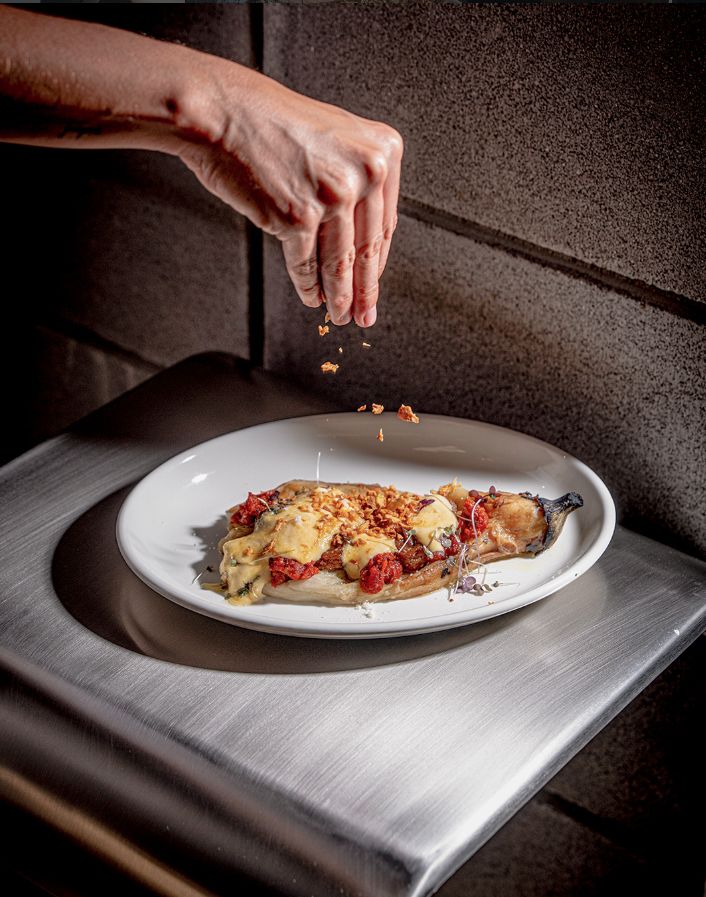
Next comes a salad of fresh and dried tomatoes with a cashew vinaigrette. For Camarena, the tomato is a constant reference point. It connects his cooking to the fertile land surrounding Valencia and to an ingredient that has appeared throughout his menus for years. At NO BAR, that relationship extends even to the walls, through photographs and references to local cultivation. “The tomato is an umbilical cord that should never be cut. It is part of our identity and reminds us that we do not need to deny where we come from,” he says.
The same balance between the familiar and the unexpected appears in the thin slices of wagyu with potatoes and mustard sauce. It is a rich dish, clean in flavour and free of unnecessary flourishes. The grilled sea bass with pepper marinade, lettuce and pistachios brings freshness, acidity and contrasting textures to the table.
Bocadillos at the Heart of the MenuSandwiches occupy a distinctive place on the menu and are a fundamental part of NO BAR. They are directly connected to the culture of the esmorzaret, the generous mid-morning meal that forms part of everyday life in Valencia.
Camarena approaches this tradition without treating it as a folkloric relic. The bocadillo retains its hearty, unpretentious character while taking on the structure and balance of a fully considered dish.
The Iberian pork pastrami comes with pickles and mustard. Blanquet i negret, two characteristic local sausages, is served in bread with baby broad beans and scrambled egg. There is also roast beef with Café de Paris sauce, melted cheese and mushrooms, as well as pork knuckle cooked with black beer.
In a city that continues to add new gastronomic addresses to its map, Camarena has turned his attention to a less predictable neighbourhood. There, behind a bar that is rarely empty, he allows the cuisine of Valencia to speak in a contemporary language.
Even if you have to wait a little to hear it.
Info: Carrer de l’Arquitecte Alfaro 44, Valencia | Tel. +34 910 05 93 96