In Pessac, just a few minutes from the city of Bordeaux, a road runs between two estates, feeling less like a boundary and more like a seam. On one side, Château Haut-Brion. On the other, Château La Mission Haut-Brion. Two great names, two “legends” that have grown side by side, two expressions of the same remarkable terroir.
Haut-Brion carries one of the oldest and most luminous narratives in all of Bordeaux. The area is linked to viticulture as far back as Roman times, while by the early 16th century the name Aubrion or Haulbrion already appears in manuscripts as a cru, marking an early assertion of identity on this land. This is where the first real fascination of Haut-Brion lies: the sense that the estate emerged alongside the very idea of great Bordeaux, at a time when many of today’s most iconic names were still in their infancy.
In 1533, Jean de Pontac acquired the rights to Château Haut-Brion, and a few years later, in 1549, construction of the estate began. During this period, the foundations of a great name were laid in an almost exemplary manner, through foresight, a deep sense of place and a firm belief in the potential of the vineyard. The Pontac family recognised early on what the wider world would come to understand much later: that this land possessed a rare ability to produce wines of refinement, remarkable precision and an aristocratic power that left an immediate impression. By the 17th century, Haut-Brion had moved beyond the confines of a distinguished local estate and was beginning to gain international recognition. In 1660, it was served at the table of King Charles II of England, while in 1663 Samuel Pepys recorded in his diary a wine of singular character. Around the same time, the Pontac family established Pontack’s Head in London, a venue that gave Haut-Brion a rare prominence in the British capital. It was there that the name began to acquire a new dimension, becoming synonymous with cosmopolitan refinement.
Many years later, when Thomas Jefferson visited Bordeaux in 1787, he recognised Château Haut-Brion as one of the finest red wines of the region. Then came 1855 and, with it, the great classification, in which Haut-Brion was granted the position it had already secured in the minds of wine lovers: Premier Grand Cru Classé. It was a defining moment, one that simply formalised a reputation long in the making. Haut-Brion had become one of the estates that helped shape the very idea of the grand vin.
In 1935, a new chapter began when Clarence Dillon acquired Château Haut-Brion. From that point onwards, the estate entered a golden era, one that brought its historical depth into an open dialogue with the demands of the modern world. Today, Prince Robert of Luxembourg, great-grandson of Clarence Dillon and Chairman and CEO of Domaine Clarence Dillon since 2008, embodies this continuity. Under his direction, Haut-Brion continues to radiate through its wines, as well as through its gastronomic presence and deeply rooted cultural identity.
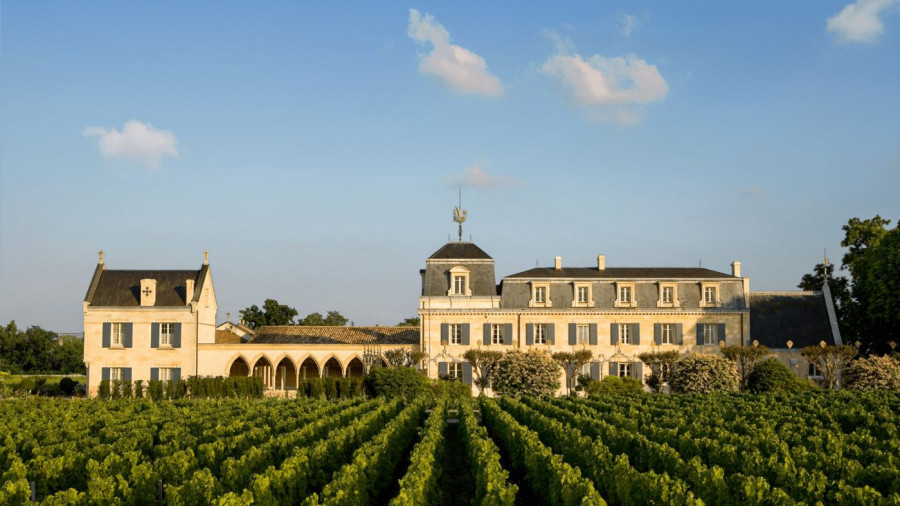
Opposite, on almost the same stretch of land, lies Château La Mission Haut-Brion (pictured above), an estate with its own weighty and distinctive history. Its origins date back to 1540, when Arnaud de Lestonnac acquired the land then known as Arregedhuys. In the same year, he married Marie de Pontac, sister of Jean de Pontac, and from that point on, the paths of the two estates became intertwined, sharing a common destiny from an early stage.
In 1682, the inheritance of Olive de Lestonnac passed to the Lazarists, from whom the estate takes its name. In 1698, the Chapelle de Notre-Dame d’Aubrion was built, a presence that continues to lend the estate an almost tangible sense of spirituality.
This may well be the element that makes La Mission so distinctive within Bordeaux. It carries prestige and a great name, even if it is sometimes unfairly viewed in the shadow of its neighbour. Yet alongside this, it possesses a deeper, more introspective intensity. Its reputation spread across the great tables of France, its wines gaining increasing prominence, and by the 19th century its place among the region’s leading estates was firmly established.
In 1919, a new era began for Château La Mission Haut-Brion under Frédéric Otto Woltner, a figure who brought a modern and lucid vision to the estate. In 1926, enamelled steel vats with vitrified linings were installed, an exceptionally forward-thinking move for the time, and in 1927 production of the estate’s white wine began. In 1983, the Dillon family acquired La Mission Haut-Brion, bringing once again under the same ownership two estates whose histories had already been intertwined since the 16th century.
From that point on, the two paths converge in a way that feels almost inevitable. Despite their differences, there is a moving sense of kinship that is difficult to ignore. The same soil, the same road, centuries of history facing one another. Together, they illustrate what can happen when a great terroir passes into the hands of those who respect it and dedicate not just their lives, but entire generations to it.
Perhaps that is why, in this small corner of Bordeaux, the region feels more compelling than anywhere else: because here, greatness has two faces, and both are unforgettable.